NASJI
NASJI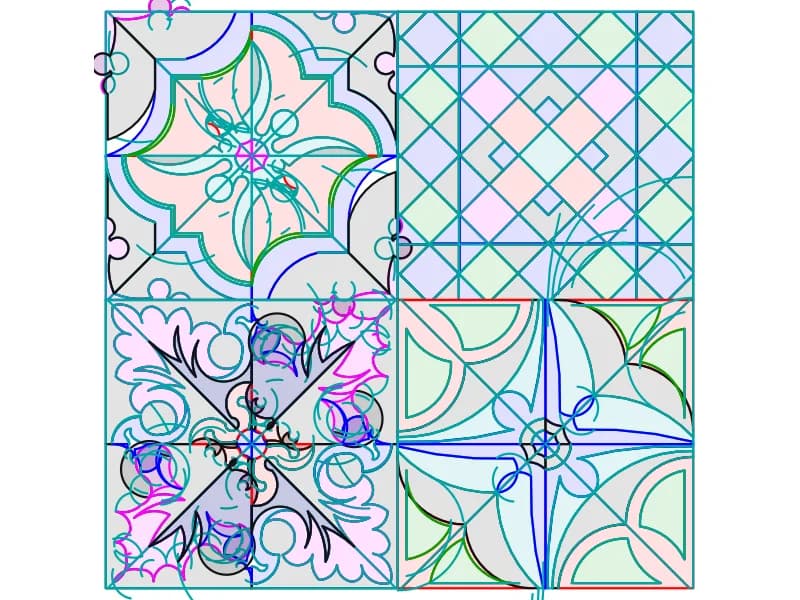
Pattern Tiles
Four ornamental cement tile designs in colour, each built from one quadrant mirrored four ways.
64 KB · 16 entities
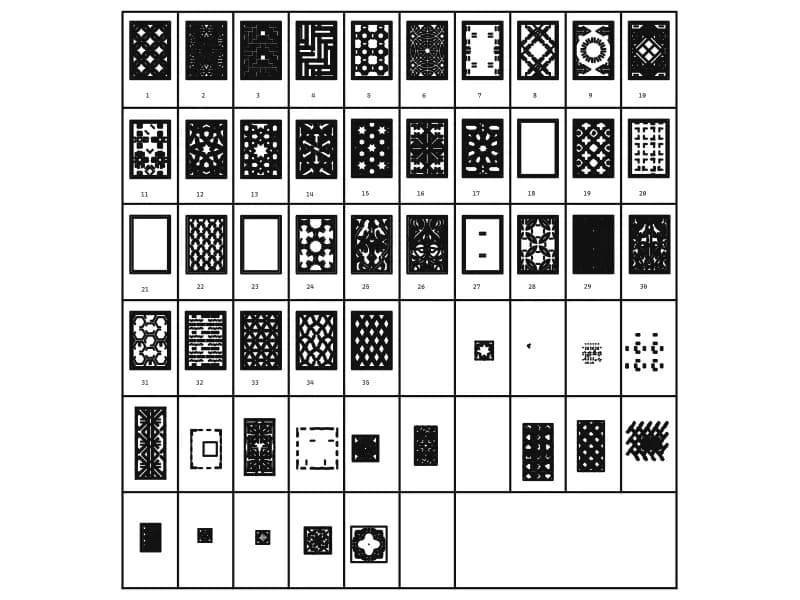
Two files, both drawn geometry rather than pattern definitions. The first is a tile sheet of thirteen inserts on the layer 44_A-WALL, each a different bond or mosaic, laid out across 26 by 9 units so it reads as a material sample board. The second is a pattern library of 35,164 entities, among them 18,364 lines and 14,234 polylines, with 35 text labels naming the layouts: herringbone, basketweave, running bond, hexagons and several interlocking paving arrangements. That library spans over nine million units end to end, so it is a full-size drawing holding many patches at once rather than one tidy sample.
Because these are real lines rather than a hatch definition, they scale and plot exactly as drawn and never vanish when a pattern scale is set wrong. Copy a patch larger than the area you are filling, place it over the room or the paving and trim it back to the boundary, then keep it on a layer below the walls with a light lineweight. For a repeating fill, take one tile from the sheet, make it a block and array it, which keeps the file far smaller than copying the patch many times over.
2 blocks · every one as DWG and DXF · free, no sign-up